New Capitals
Latest Study | Energy Transition at the Edge of a New Order
Latest Study | Energy Transition at the Edge of a New Order
May 13, 2026
Abundant Climate
May 13, 2026
Abundant Climate
Beijing, May 13, 2026 - Abundant Climate Action Institute today released Energy Transition at the Edge of a New Order: Scaling Renewable Energy Deployment in South and Southeast Asia Markets, a cutting-edge study examining renewable energy markets across eight countries in Southeast and South Asia (including Singapore, Malaysia, Indonesia, Vietnam, Thailand, Philippines, Pakistan, and Bangladesh) amid fast-paced global shifts. The study finds that the fracturing of the post-WWII multilateral order across monetary systems, geopolitical alliances, and trade architecture has fundamentally altered the conditions for renewable energy investment, making the transition simultaneously more urgent and more difficult to finance.
The study documents the region at a historic inflection point: one in which fossil fuel import dependence has transformed from an economic liability into a sovereignty risk, as Southeast Asia rapidly consolidates and deepens its position in the global green value chain. Yet the capital architecture required to accelerate the transition has not kept pace with the scale of need, and closing that gap will demand not only more capital, but a new generation of financial instruments designed for the complexity of emerging markets.
Key Findings
The old order's assumptions no longer hold
The report identifies three structural shifts driving the new operating environment at regional and global level: a destabilized global financial system in which mounting sovereign debt is consuming the growth it once funded; a geopolitical order in which states now prioritize domestic political interests over multilateral obligations; and AI boom has restructured energy demand while a trade architecture being reorganized around strategic control rather than comparative advantage. Together, these forces are reshaping how clean energy is financed, built, and governed across the region.
Southeast Asia is the indispensable node in the global green supply chain
As China continues to play a dominant role in solar and battery manufacturing, and the United States redefines its engagement with multilateral climate efforts, Southeast Asia has emerged as the contested middle ground where global capital, technology, and geopolitical influence converge. The ongoing Iran crisis has deepened this dynamic, exposing the region's acute dependence on imported fossil fuels and elevating renewable energy from a climate objective to a strategic imperative for national industrial resilience. Abundant Climate's analysis reveals that Southeast Asia is structurally embedded in the solar and battery value chain, with solar and wind announced generation capacity that grew nearly fivefold between 2020 and 2024 and over 400GWh of battery cell manufacturing capacity added during the same period.
Capital needs are real, calling for differentiated financial instruments across markets
The report segments the eight markets into three distinct financing tiers. Malaysia and Thailand are transition-ready with relatively low cost of capital and strong regulatory frameworks, requiring instruments that unlock non-concessional private finance at scale. Indonesia, Vietnam, and the Philippines face moderate costs of capital and structural barriers, including fossil fuel subsidies and grid fragmentation, that require sustained de-risking through blended finance and first-loss capital. Pakistan and Bangladesh carry the highest capital costs and require concessional debt, grant-based catalytic capital, and institutional capacity building before commercial investment can flow at scale. Meanwhile, Singapore plays a unique role as regional capital gateway and cross-border electricity trade coordinator.
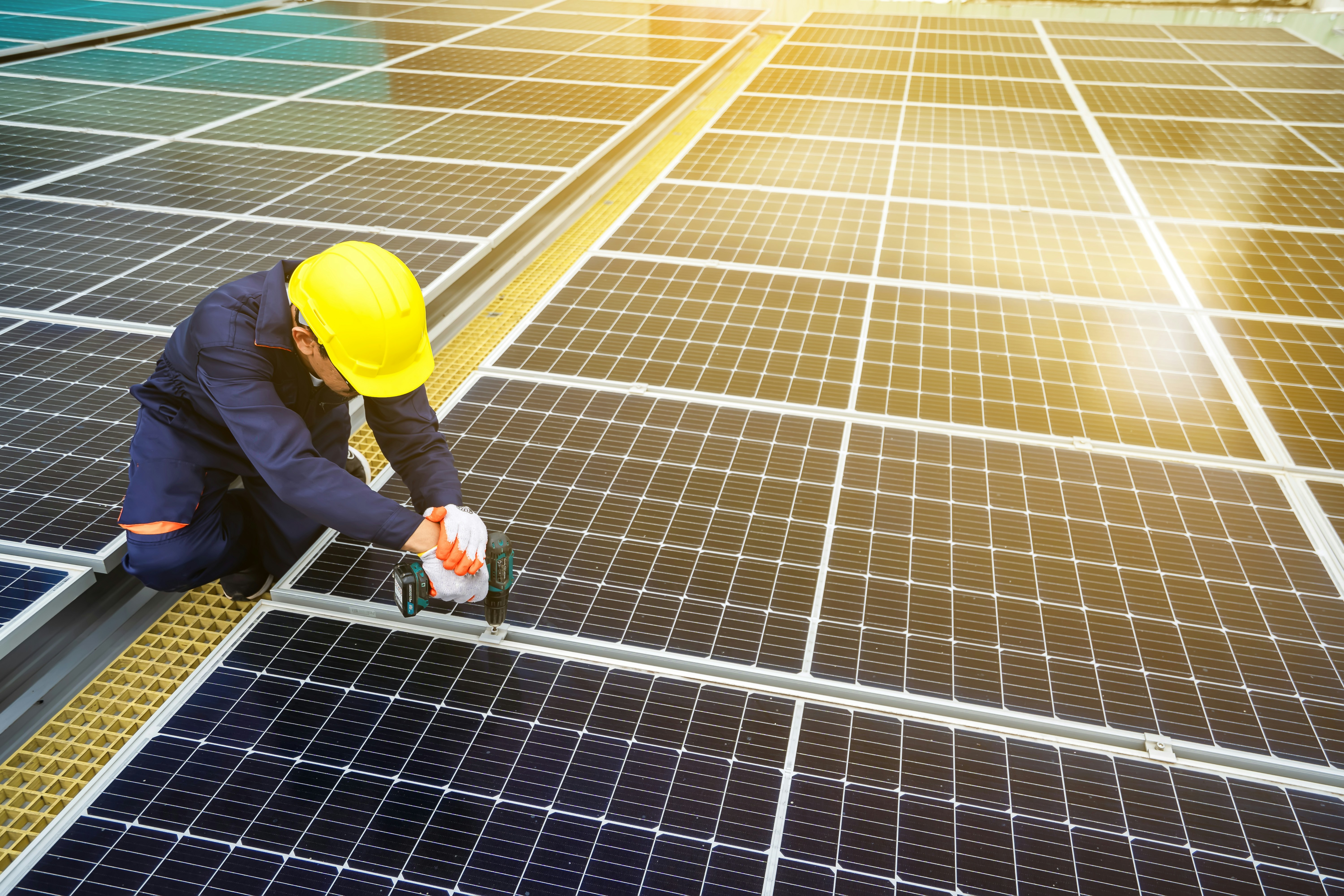
A worker builds a solar panel system on a house roof in Thailand, from Unsplash.
Rethinking Financing Architecture
A central argument of the report is that the region's financing gap cannot be closed by commercial capital alone but that solution should be structural. The report calls for a fundamentally more sophisticated capital stack, one in which public, development, and philanthropic capital play an active architectural role rather than a supporting one."
Vivian Li, Project Manager at Abundant Climate Action Institute said:
South and Southeast Asia doesn't just need more capital for green energy transition, but a more diversified financing architecture. The transition demands a financing stack sophisticated enough to price real risk, imaginative enough to deploy philanthropic and impact capital beyond grants, and patient enough to absorb first losses and build the markets so that commercial finance will eventually scale.
Four Possible Futures: 2031 and Beyond
The report identifies AI-driven computing power demand as a potential game changer for the region's energy trajectory. Technology giants' appetite for clean, reliable power is creating a new class of anchor demand: one that could accelerate grid investment, attract private capital, and create aligned incentives for regional coordination that governments alone have struggled to produce.
The report presents four future scenarios of SEA's clean energy transition shaped by two critical uncertainties: the degree of regional & geopolitical collaboration, and the availability of green capital.
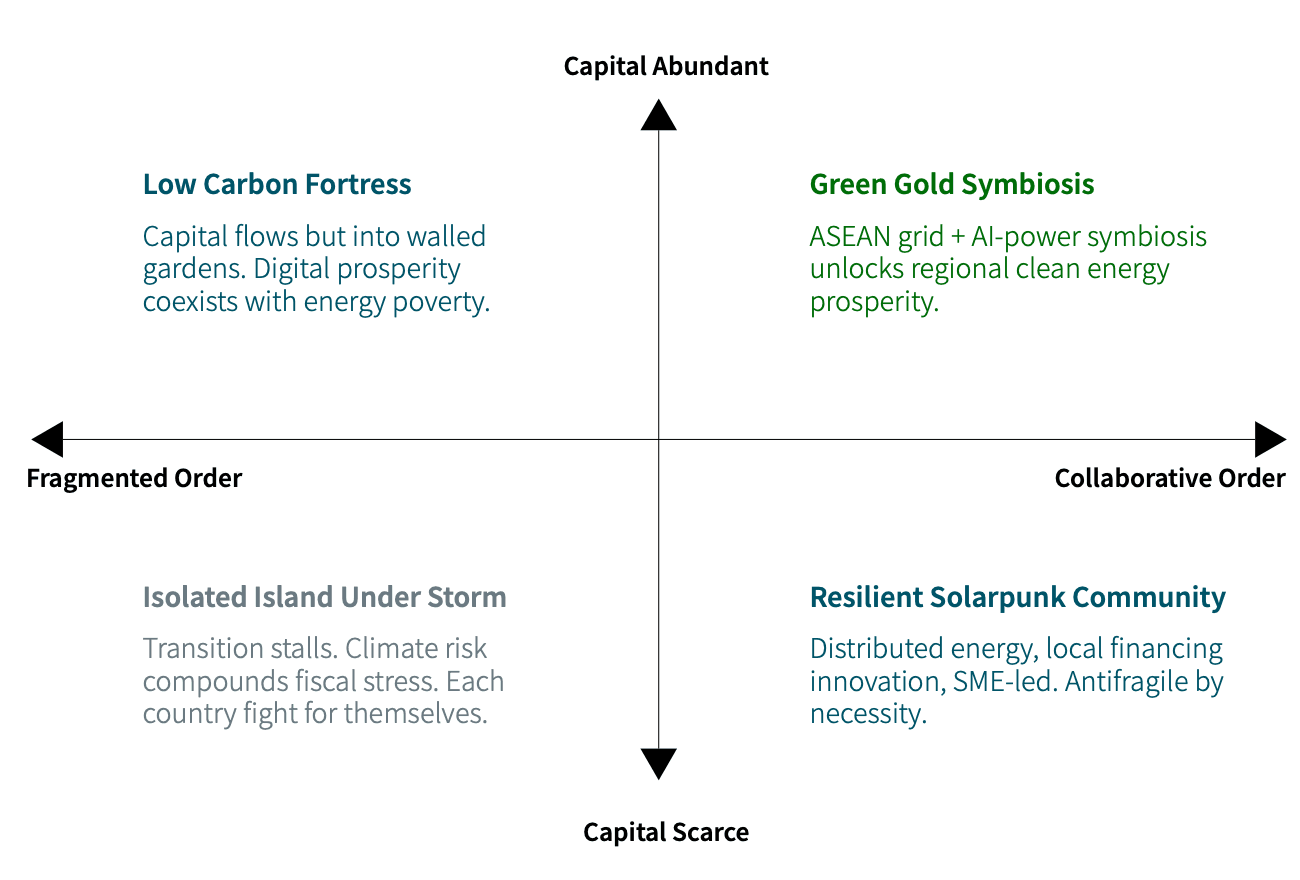
Reaching the more favorable 'Green Gold Symbiosis' scenario where renewable energy prosperity is shared across the region rather than concentrated in isolated pockets will require two things to move in tandem: supportive policies at home together with genuine collaboration across borders, and financing mechanisms sophisticated and patient enough to absorb risks and build markets from the ground up. Even with potential shocks of international green capital scarcity, deep collaborations as well as incentivized bottom-up financial and business innovation could still pave the way towards a resilient future.
Abundant Climate is actively seeking collaboration with policy makers, financial institutions, philanthropic foundations, and corporations to jointly explore climate finance innovations. In parallel, we will continue to pursue research and practices related to regional collaboration and financial tools that support energy transition and catalyze capital for early-stage climate solutions. If you are interested in partnering with us, please visit abundantclimate.com or contact us at info@abundantclimate.com.
Beijing, May 13, 2026 - Abundant Climate Action Institute today released Energy Transition at the Edge of a New Order: Scaling Renewable Energy Deployment in South and Southeast Asia Markets, a cutting-edge study examining renewable energy markets across eight countries in Southeast and South Asia (including Singapore, Malaysia, Indonesia, Vietnam, Thailand, Philippines, Pakistan, and Bangladesh) amid fast-paced global shifts. The study finds that the fracturing of the post-WWII multilateral order across monetary systems, geopolitical alliances, and trade architecture has fundamentally altered the conditions for renewable energy investment, making the transition simultaneously more urgent and more difficult to finance.
The study documents the region at a historic inflection point: one in which fossil fuel import dependence has transformed from an economic liability into a sovereignty risk, as Southeast Asia rapidly consolidates and deepens its position in the global green value chain. Yet the capital architecture required to accelerate the transition has not kept pace with the scale of need, and closing that gap will demand not only more capital, but a new generation of financial instruments designed for the complexity of emerging markets.
Key Findings
The old order's assumptions no longer hold
The report identifies three structural shifts driving the new operating environment at regional and global level: a destabilized global financial system in which mounting sovereign debt is consuming the growth it once funded; a geopolitical order in which states now prioritize domestic political interests over multilateral obligations; and AI boom has restructured energy demand while a trade architecture being reorganized around strategic control rather than comparative advantage. Together, these forces are reshaping how clean energy is financed, built, and governed across the region.
Southeast Asia is the indispensable node in the global green supply chain
As China continues to play a dominant role in solar and battery manufacturing, and the United States redefines its engagement with multilateral climate efforts, Southeast Asia has emerged as the contested middle ground where global capital, technology, and geopolitical influence converge. The ongoing Iran crisis has deepened this dynamic, exposing the region's acute dependence on imported fossil fuels and elevating renewable energy from a climate objective to a strategic imperative for national industrial resilience. Abundant Climate's analysis reveals that Southeast Asia is structurally embedded in the solar and battery value chain, with solar and wind announced generation capacity that grew nearly fivefold between 2020 and 2024 and over 400GWh of battery cell manufacturing capacity added during the same period.
Capital needs are real, calling for differentiated financial instruments across markets
The report segments the eight markets into three distinct financing tiers. Malaysia and Thailand are transition-ready with relatively low cost of capital and strong regulatory frameworks, requiring instruments that unlock non-concessional private finance at scale. Indonesia, Vietnam, and the Philippines face moderate costs of capital and structural barriers, including fossil fuel subsidies and grid fragmentation, that require sustained de-risking through blended finance and first-loss capital. Pakistan and Bangladesh carry the highest capital costs and require concessional debt, grant-based catalytic capital, and institutional capacity building before commercial investment can flow at scale. Meanwhile, Singapore plays a unique role as regional capital gateway and cross-border electricity trade coordinator.
A worker builds a solar panel system on a house roof in Thailand, from Unsplash.
Rethinking Financing Architecture
A central argument of the report is that the region's financing gap cannot be closed by commercial capital alone but that solution should be structural. The report calls for a fundamentally more sophisticated capital stack, one in which public, development, and philanthropic capital play an active architectural role rather than a supporting one."
Vivian Li, Project Manager at Abundant Climate Action Institute said:
South and Southeast Asia doesn't just need more capital for green energy transition, but a more diversified financing architecture. The transition demands a financing stack sophisticated enough to price real risk, imaginative enough to deploy philanthropic and impact capital beyond grants, and patient enough to absorb first losses and build the markets so that commercial finance will eventually scale.
Four Possible Futures: 2031 and Beyond
The report identifies AI-driven computing power demand as a potential game changer for the region's energy trajectory. Technology giants' appetite for clean, reliable power is creating a new class of anchor demand: one that could accelerate grid investment, attract private capital, and create aligned incentives for regional coordination that governments alone have struggled to produce.
The report presents four future scenarios of SEA's clean energy transition shaped by two critical uncertainties: the degree of regional & geopolitical collaboration, and the availability of green capital.
Reaching the more favorable 'Green Gold Symbiosis' scenario where renewable energy prosperity is shared across the region rather than concentrated in isolated pockets will require two things to move in tandem: supportive policies at home together with genuine collaboration across borders, and financing mechanisms sophisticated and patient enough to absorb risks and build markets from the ground up. Even with potential shocks of international green capital scarcity, deep collaborations as well as incentivized bottom-up financial and business innovation could still pave the way towards a resilient future.
Abundant Climate is actively seeking collaboration with policy makers, financial institutions, philanthropic foundations, and corporations to jointly explore climate finance innovations. In parallel, we will continue to pursue research and practices related to regional collaboration and financial tools that support energy transition and catalyze capital for early-stage climate solutions. If you are interested in partnering with us, please visit abundantclimate.com or contact us at info@abundantclimate.com.

Looking for new ideas & resonance?
We work with climate changemakers of all kinds:
Entrepreneurs, investors, philanthropists, non-profit activists, futurists, writers, to bring in innovation and resources - Raindrops💧, sunshine☀️ and ways of growth🌱 to the forest.
Get in touch

Looking for new ideas & resonance?
We work with climate changemakers of all kinds:
Entrepreneurs, investors, philanthropists, non-profit activists, futurists, writers, to bring in innovation and resources - Raindrops💧, sunshine☀️ and ways of growth🌱 to the forest.
Get in touch
Looking for new ideas & resonance?
We work with climate changemakers of all kinds:
Entrepreneurs, investors, philanthropists, non-profit activists, futurists, writers, to bring in innovation and resources - Raindrops💧, sunshine☀️ and ways of growth🌱 to the forest.